
Dozens of valleys run through the Catalan Pyrenees between the western end and their “outfall” in the east beyond the Cap de Creus peninsula into the Mediterranean. Its appeal is primarily due to the combination of Atlantic (in the west) and Mediterranean (in the east) climate, which supports a diverse range of flora and fauna – further enhanced by the views that are available in many places. One of these wonderful valleys is called Boí. And that’s exactly where we’re going now!

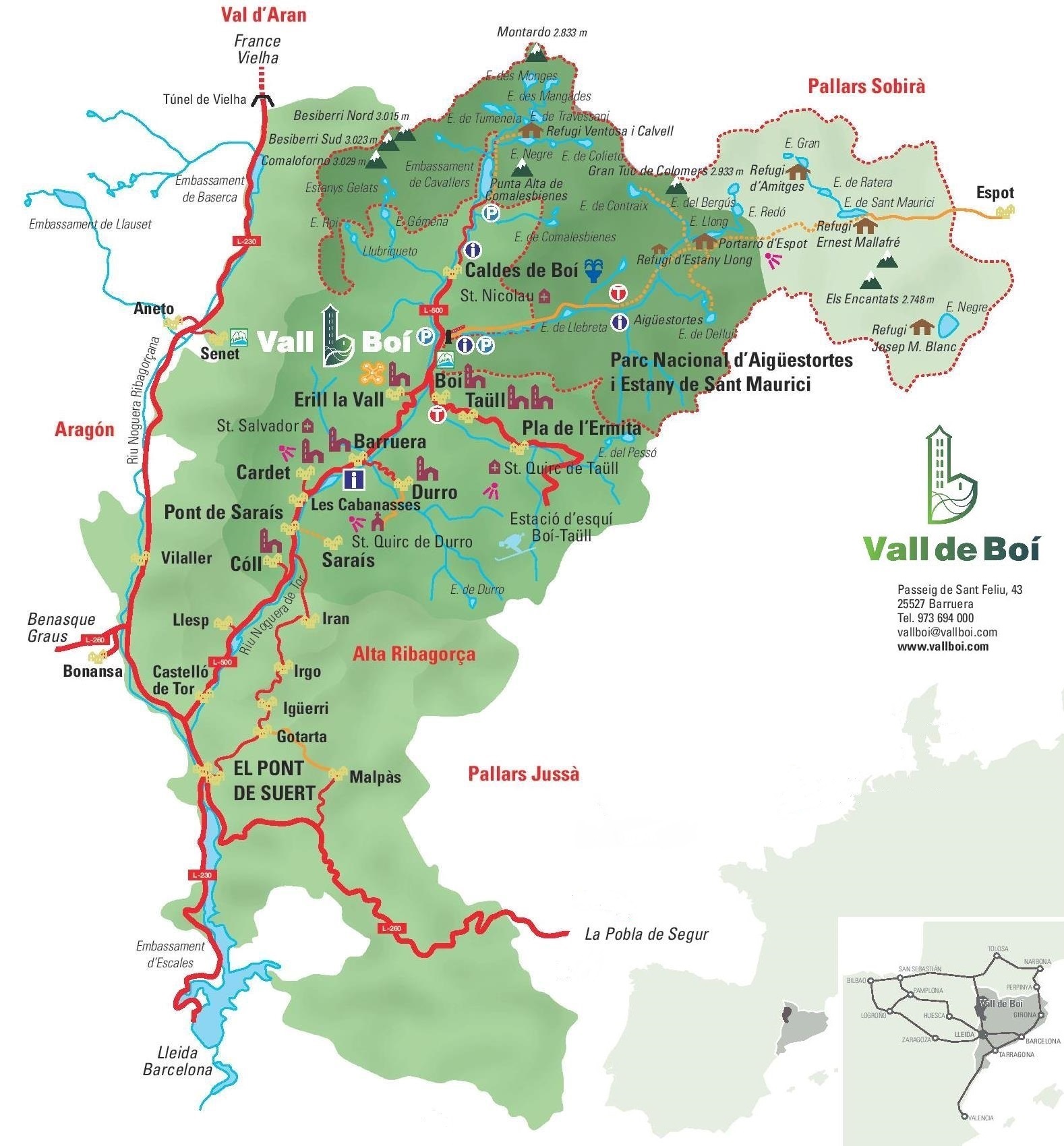
In addition to its exceptional world heritage, the Boítal offers direct access to the Aigüestortes i Estany de Sant Maurici National Park. The Vall de Boí, which borders Aragon, is crossed by the tributary Noguera de Tor, which rises in the north at the Cavallers reservoir and flows into the main river Noguera Ribagorçana about 25 kilometers further. The Noguera de Tor represents, in a sense, the spine of the valley, together with the L-500 national road that follows its course. The valley can be easily explored from El Pont de Suert via the L-500.
Many things, but above all architecture – and what an amazing one!
Bathing culture, hiking trails and riding trails, cycle tourism or mountaineering: a stay in the Vall de Boí offers all this and more, as shown on the Vall de Boí Tourism website can be seen. Nevertheless, architecture and history are two terms that describe the Boítal excellently. No fewer than eight churches and a pilgrimage chapel have shaped the country and its people since the early Middle Ages. In fact, the valley is home to the largest concentration of Romanesque art in all of Europe – an impressive open-air museum!
The tourist office is located in the village of Barruera (approx. 200 residents). It is advisable to start the route here, where you can find out more about the general offerings in the valley, such as the Aigüestortes National Park, the only one of its kind in Catalonia and another showpiece of the region.
Barruera itself is home to one of the nine places of worship that UNESCO declared a World Heritage Site in 2000. The origins of the Church of Sant Feliu go back to the 11th century; and hardly any other church has experienced more transformations over the course of its history. Art connoisseurs will quickly notice the different architectural styles that make up Sant Feliu – such as the two apses. The central altar niche from the 11th century appears more irregular and coarser than the slightly smaller one to the south, which was added a good century later.
The L-500 road runs through the Vall de Boí.
The Romanesque Center that explains the past
Towards the north, four more churches await visitors to the Boí Valley, each more fascinating than the last. The square, delicate bell tower of Santa Eulàlia d’Erill la Vall, one of the most spectacular in the entire valley, is an excellent example of the so-called “Lombard architectural style” that spread from Italy to other European regions. The tower is an impressive six stories high, which at the time enabled communication with the two churches that, interestingly, form a line with Santa Eulàlia: Sant Joan de Boí and Sant Climent de Taüll.
In Erill la Vall there is also the so-called Centre del Romànic. There the visitor receives information about the architectural heritage of the valley, including the Romanesque period in the region, medieval society and the construction techniques that were used in the construction and interior design of the churches.

An extensive restoration in the 1970s returned Sant Joan de Boí to its former glory, as shown in the image below.

Barely five minutes away by car, you practically stumble upon Sant Joan de Boí. The church shares its three-aisled floor plan (similar to a basilica) with Sant Climent and Santa Maria in neighboring Taüll. Particularly worth seeing are the murals that were restored a few decades ago and now make Sant Joan look like it originally did.
The almost straight line from Santa Eulàlia in the west via Sant Joan, Santa Maria and Sant Climent finds its eastern end in Taüll. In the past, the village had three churches and a pilgrimage chapel. However, one of these four buildings has given in to the “ravages of time” and so only a few stones remain from Sant Martí. Of the three remaining churches, Sant Climent de Taüll is the undisputed gem of the entire valley. 🤩
The risen Christ of Taüll
In particular, the so-called Majestas Domini (‘Glory of the Lord’) or also Pantrokrator (‘Ruler of the World’) in the apse cap, the semi-dome-shaped apse vault, characterized the interior of the church for centuries. The original wall painting of this wonderful Pantocrator was, like many art treasures from the valley, carefully removed at the beginning of the 20th century and moved to the Museu Nacional d’Art de Catalunya to be used by the to preserve posterity.
In its place, an impressive so-called video mapping has recently been projected, which traces the production process of the work of art from the first strokes to completion. This 10-minute audiovisual reconstruction has never left any viewer unimpressed!
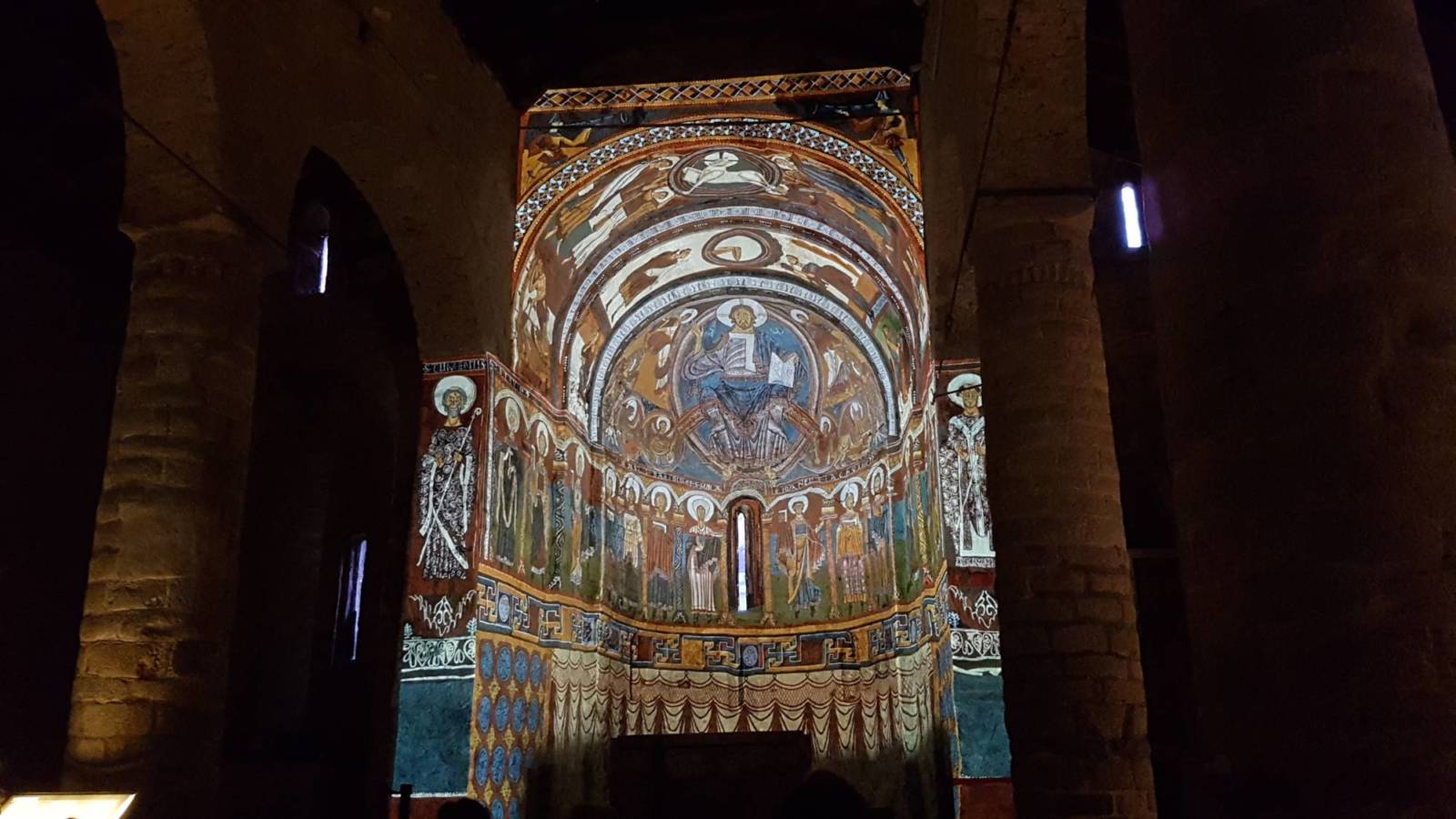
An absolute must on any trip to the Boí Valley is the video mapping in Sant Climent.

Other biblical scenes or figures can be seen in the church, such as Cain and Abel or Lazarus; and of course its namesake, Saint Clement, should not be missing.
Five minutes away is the second church in the village, which is also a UNESCO World Heritage Site: Santa Maria de Taüll. In a sense it is the “little sister” of Sant Climent, consecrated on December 10, 1123, as Santa Maria followed just a day later.
In the interior, a replica of the central apse, which shows a scene from the Epiphany, catches the eye. The Three Wise Men, who venerate the child Jesus, are also the protagonists on the south wall. In the 18th century the church was extensively rebuilt in the Baroque style, but was later restored to its original Romanesque state. Its slightly sloping tower has five identically decorated floors.
A chapel with an (awesome) view
From Taüll you can reach Durro in just under a quarter of an hour via the L-500. The quiet, winding country road “carretera de Durro” gives a taste of the magnificent landscape that lies beneath this village. At the destination at 1,400 meters above sea level, the tower of the dominant Nativity de Durro towers over the roofs of the town. It was built in the second half of the 12th century – later than the other houses of worship down in the valley.

From the Sant Quirc hermitage there are sweeping views of the mountains and the village of Durro to which it belongs.
Half an hour on foot or five minutes by car is enough to get to the pilgrimage chapel of Sant Quirc de Durro. This hermitage, also included in the UNESCO list, is characterized by its graceful simplicity as well as its privileged location – its visit is no less worthwhile than the other eight (classic) houses of worship.
The two southernmost churches
Back towards El Pont de Suert, there are two more churches along the route. Santa Maria de Cardet has one of the most spectacular apses in the entire Vall de Boí. What’s more: it is the only one of the nine amazing churches a bell gable that is rather unusual for the valley.
The World Heritage List is completed by the Church of Assumpció del Coll with its small, robust tower and three Romanesque pools in the interior: baptismal font, oil font and holy water font.

The “Església de la Nativitat” (“Church of the Nativity”) stands in the middle of the picturesque and listed Durro.
The Vall de Boí continues in Barcelona
Many original works of art were carefully removed and primarily placed in the Museu Nacional d’Art de Catalunya MNAC, in Barcelona. This had a double purpose: to prevent their plunder and to protect them from the harsh weather conditions in the region.
You can buy a ticket at the Centre del Romànic in Erill la Vall. The ticket includes a visit to all open churches in the valley as well as the MNAC in Barcelona. Click here for details.
More details about the Boí Valley can be found through this link: www.vallboi.cat/en.
📸 All photos © Ferran Porta (map Vall de Boí © Turisme Vall de Boí)