Salvador Dalí’s art was limitless. It found expression in painting, drawing, and printmaking, sculpture and architecture, photography, cinema, literature, and, ultimately, jewelry. Each of Dalí’s works spanned an entire universe of meaning. The artist with perhaps the most famous mustache in history was an egocentric mystic with a hellish sense of humor. He was a master of self-dramatization who made of creative work his life’s work. Consequently, he also transformed the numerous contradictory facets of his dazzling personality into a work of art.
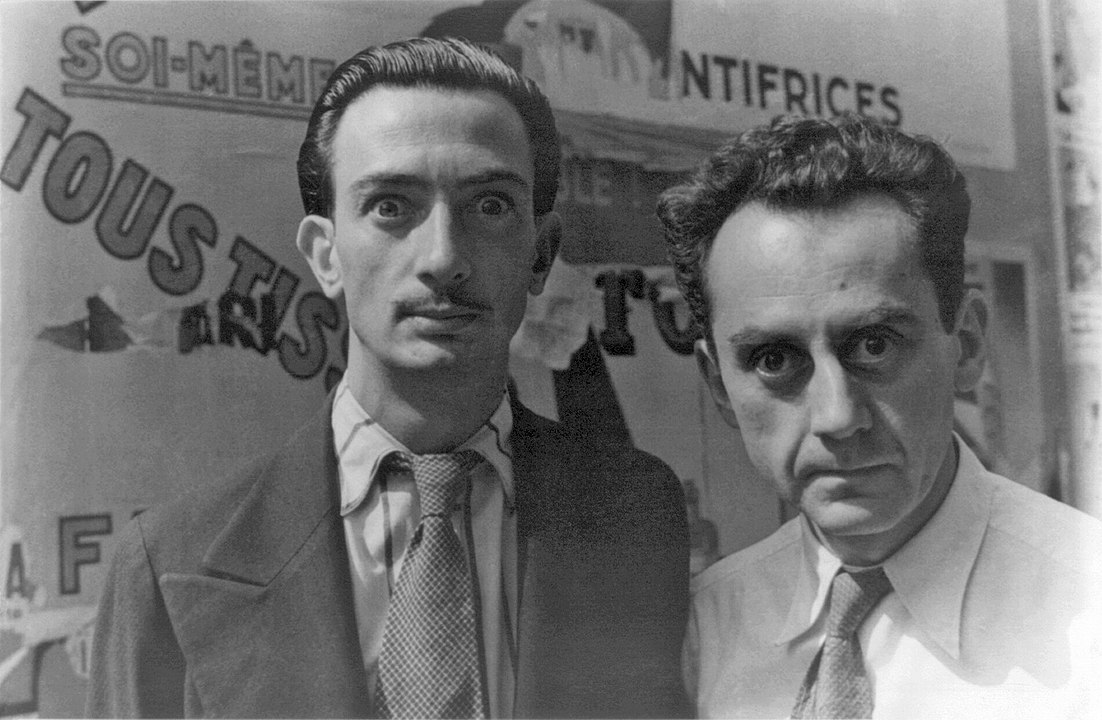
Dalí (left) and PA-born visual artist Man Ray in Paris on 16 June 1934
The Dalinian Triangle
Salvador Dalí is no less enigmatic than his work. One thing is certain, however: the visionary potential of the famous Catalan artist grows from his deep connection with the landscapes of his homeland on the Costa Brava. Figueres, Portlligat, and Púbol are the names of the towns that have shaped Dalí’s life and work, and have been shaped by him to the same extent. If these three places are connected on the map to form a geometric figure, the Dalí Triangle emerges.
Dalí Theater-Museum
The Dalí Theater-Museum in Figueres is not just a museum. It is a self-contained work of art that defines itself as “the greatest Surrealist object in the world.” Salvador Dalí himself conceived it with the intention of transporting visitors into the heart of his captivating inner world. The master, without false modesty, expressed its transcendent significance as follows: “It’s obvious that other worlds exist, that’s certain; but, as I’ve already said in many other occasions, these other worlds are inside ours, they reside on earth and are precisely at the centre of the dome of the Dalí Museum, which contains the new, unsuspected and hallucinatory world of Surrealism.”

The Theater-Museum’s collection allows visitors to explore Dalí’s entire artistic career through a wide range of his works: from Dalí’s early work, which still experimented within the context of Impressionism, Futurism, and Cubism, to Nuclear Mysticism, a style of painting developed by himself, in which he pays homage to Michelangelo and Leonardo da Vinci. Also obviously his Surrealist works, with which he became famous.
Dalí and Figueres
But how did this unique museum come into being? In the 1960s, the then mayor of Figueres, Ramon Guardiola, asked Dalí whether he would donate a piece of his work to the Empordà Museum. The artist responded with the plan of gifting an entire museum to his native town. The museum’s website quotes Dalí’s following line of thought: “Where, if not in my own town, should the most extravagant and solid of my work endure? The Municipal Theatre, or what remained of it, struck me as very appropriate, and for three reasons: first, because I am an eminently theatrical painter; second, because the theatre stands right opposite the church where I was baptised; and third, because it was precisely in the hall of the vestibule of the theatre where I hosted my first exhibition.”
Dalí Jewelry
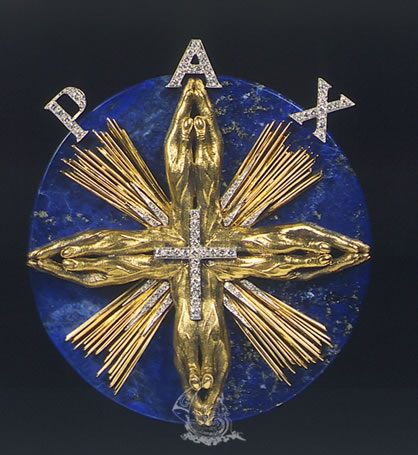
Peace Medal
Also housed in the Dalí Theater-Museum is a collection of jewelry designed by Dalí from the most precious materials. Spread over two floors, this collection is located in an annex to the museum. In this unique ensemble of jewelry, Salvador Dalí set the entire spectrum of his artistic expression in gold, precious stones, pearls, and coral. Therefore, all the pieces exhibited here are not only originals, but also unique.
When asked about the frivolous nature of some of his jewelry, Dalí replied: “Illusory! Dalí’s jewelry must be taken very seriously. I am pleased if my earrings in the shape of telephones make the viewer smile. A smile is a pleasant thing. But the earrings, like all my other jewelry, are serious works of art. The pendants represent the ear as a symbol of harmony and unity. They connote the speed of modern communication media; the opportunities and dangers inherent in the lightning-fast exchange of ideas.”.
Castell Gala Dalí in Púbol
Salvador Dalí is quoted as saying, “Every morning when I wake up, I enjoy the sublime pleasure of being Salvador Dalí. Filled with amazement, I wonder what wonderful thing this Dalí will accomplish today.” Undoubtedly, the master thought highly of himself. Nevertheless, it would be a mistake to believe that Dalí only revolved around himself. At the center of his life was his wife and muse, Gala. Dalí himself saw his relationship with Gala as best represented by the ideal of courtly love. Consequently, it was natural that he would give his lady a castle in which she would be the queen.
Dalí’s ability to materialize seemingly surreal ideas reached a new dimension in 1969 with the acquisition of an old castle in Púbol. The medieval building, with its collapsed roofs, cracked walls, and a half-overgrown garden, sparked a new, exuberant form of creativity in him. During the restoration work, he effectively showcased the scars left by time on the old walls. He used the effect of half-collapsed walls to create unexpected spatial images. Murals and simulated architecture play with the viewer’s perception. Combined with baroque-style textile decorations, antiques, and romantic symbols, Dalí created a place full of mystery and surprises in the Gala Dalí Castle of Púbol.
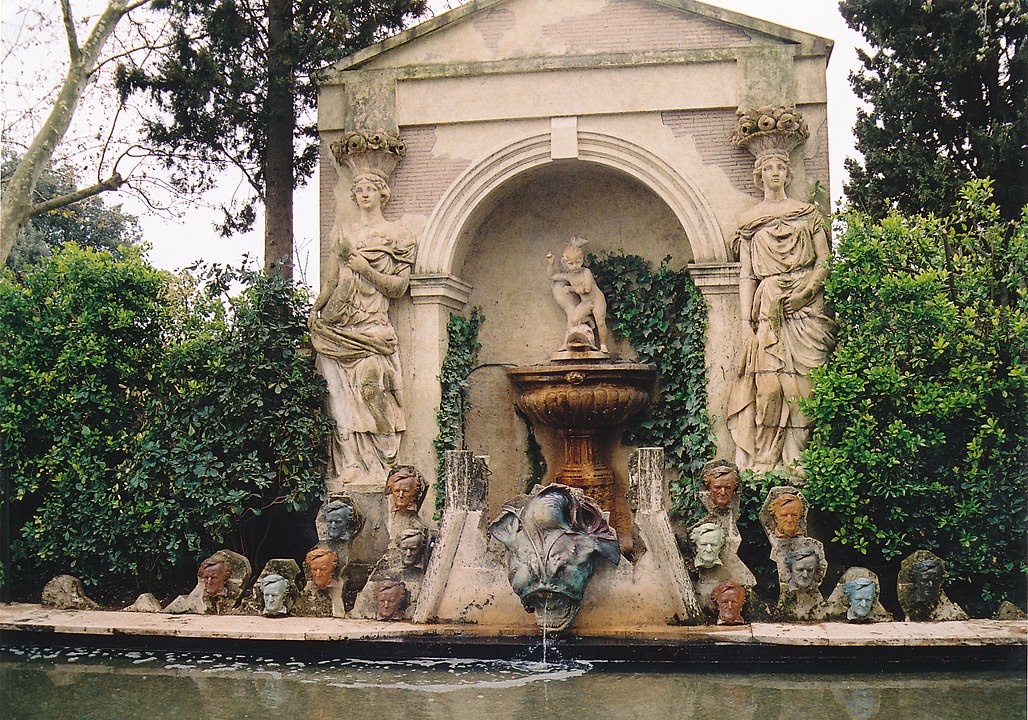
Fountain in the garden of Púbol castle decorated with busts of the composer Richard Wagner.
Dalí and Love
Dalí described himself as a thoroughly theatrical painter. In this respect, it is not surprising that he also acted with undisguised pathos in his love: “I wanted to give Gala a shell worthy of our love in a solemn way. Therefore, I gave her a residence in La Bisbal, built on the remains of a 12th-century castle. In the old castle of Púbol, she reigns as absolute sovereign, to the point that I don’t visit her unless I receive a written invitation from her first. I have contented myself with decorating the ceilings of her chambers so that whenever she raises her eyes, she will find me in her heaven.” Since 1996, Castell Gala Dalí, which served as the artist’s home and studio in his final years after Gala’s death, has been open to visitors.
Casa Salvador Dalí – Portlligat
The Salvador Dalí House in Portlligat was Dalí’s home, where he lived and worked, for over 50 years. The landscape, the light, and the isolation of the place prompted him to buy a small fisherman’s hut here in 1930. He converted it into a home, which grew and changed shape over the years. This change followed the same laws “as a true biological structure […] Each new impulse in our life corresponded to a new cell, a new room,” according to Dalí.
The result of this “organic” construction is an interwoven structure of rooms and corridors reminiscent of a labyrinth. Narrow passageways, slight changes in elevation, and rooms filled with a variety of Dalí objects and memorabilia characterize the space. Carpets, whitewashed walls, dried flowers, velvet upholstery, and antiques further define the atmosphere of the place. The most significant design element, however, are the openings in the rooms, whose various shapes frame the surrounding landscape.

View of the Salvador Dalí House Museum (center), in Portlligat.
This very landscape of Portlligat is a constant in Salvador Dalí’s work. Moreover, it is also the pivotal point of his artistic creation. Dalí himself said of it: “Portlligat is the place of realizations. It is the perfect place for my work. Everything conspires to make it so: time passes more slowly, and each hour has its own dimension. There is a geological calm: the place is a planetary anomaly.”
Anyone visiting Casa Dalí Portlligat today will find the house divided into three areas: the rooms used privately by Salvador and Gala Dalí, the studio, which contains numerous objects that provide insight into the master’s artistic work, and the outdoor areas, which are primarily used for public events.
Further information and tickets to all museums are available on the website www.salvador-dali.org. Those who would like to get a first glimpse of the museums can take a virtual tour of the museums there.
Source: www.katalonien-tourismus.de